AIRE Demo Night Recap | AI in Real Estate Event Los Angeles
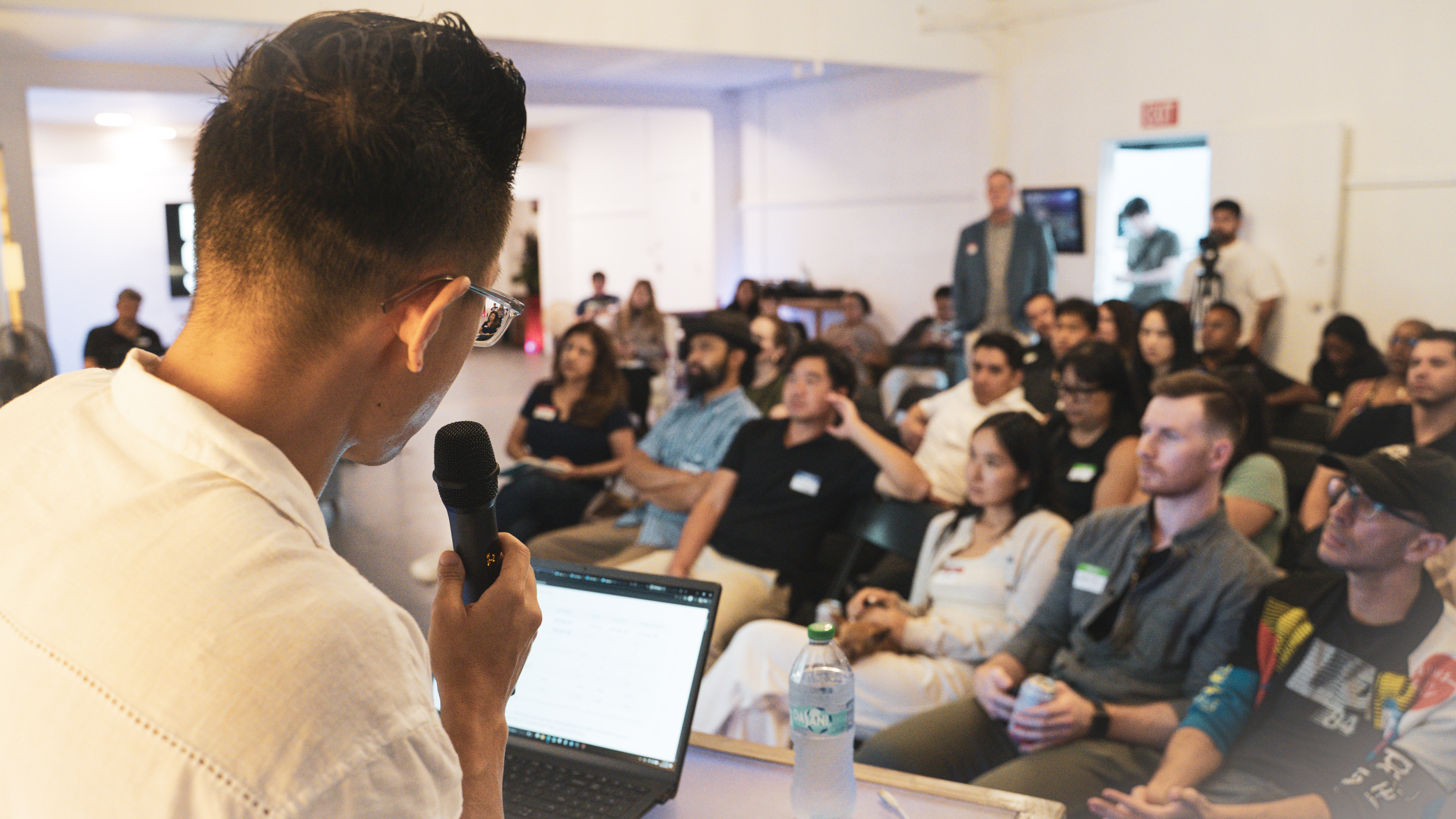
On June 11, 2026, real estate professionals, investors, operators, and technology enthusiasts gathered in Los Angeles for AIRE’s (AI for Real Estate) Demo Night—an evening dedicated to exploring how artificial intelligence is actively reshaping the future of real estate.
Hosted by Andy Choi, the event brought together professionals from across real estate and technology to discuss one central question:
What happens when AI moves beyond hype and starts
delivering real operational value in real estate?
The answer became increasingly clear throughout the night: AI is no longer a future concept—it is already transforming how deals are analyzed, how workflows are automated, and how businesses scale.
From live demos and practical case studies to real-world AI applications in underwriting, operations, and lead conversion, Demo Night offered attendees a front-row seat to the next era of real estate innovation.
Why AIRE Exists
Andy Choi opened the evening by sharing the mission behind AIRE.
Real estate has historically been one of the slowest industries to adopt emerging technology. While other sectors rapidly embraced automation, data intelligence, and AI-driven systems, much of real estate has continued to rely on manual workflows, fragmented processes, and disconnected tools.
AIRE was created to change that.
Its mission is simple but powerful:
Bring together the brightest minds in real estate and technology
Foster collaboration between builders and operators
Accelerate AI adoption across the real estate industry
Andy emphasized an important mindset shift:
AI is not here to replace people. AI is here to empower people.
That message became the foundation of the entire event.
The Real Opportunity: AI as Competitive Advantage
One of the strongest themes of the evening was competitive leverage.
The professionals who understand AI early will gain a significant advantage over those who delay adoption.
In real estate, even small efficiency gains create major business advantages. Faster underwriting, better lead qualification, quicker decision-making, and improved operational efficiency can directly impact revenue.
Attendees explored how AI creates leverage by helping teams:
Analyze deals faster
Reduce manual research
Improve data-driven decision making
Automate repetitive administrative tasks
Scale operations without proportionally increasing headcount
The takeaway was clear:
AI adoption is no longer optional for firms that want to remain competitive.
Live Demo: AI-Powered Real Estate Underwriting

One of the most valuable parts of Demo Night was a live demonstration of AI-assisted underwriting.
Traditionally, underwriting multifamily and commercial real estate deals requires extensive manual analysis. Investors must review multiple documents, analyze financials, evaluate risks, and compare market assumptions before making investment decisions.
This process is often slow and labor-intensive.
During the live demo, attendees saw how AI can dramatically accelerate underwriting by processing critical deal inputs such as:
Offering Memorandums (OMs)
T12 financial statements
Property performance data
Market assumptions
Deal documentation
The AI workflow rapidly surfaced important insights, including:
Cap rate considerations
Return projections
Risk indicators
Deal red flags
Buy / no-buy signals
Instead of spending hours manually sorting through documents, AI helped reduce analysis time while improving visibility into potential risks.
This demonstrated one of AI’s most practical real estate applications: faster, smarter investment analysis.
AI Agents and Workflow Automation

Another major focus of the event was AI agents.
Beyond chat interfaces like ChatGPT or Claude, speakers discussed how AI agents can perform structured tasks inside real business workflows.
These systems can:
Execute repeatable processes
Handle multi-step operations
Pull information from APIs
Trigger automations
Assist decision-making across departments
Rather than treating AI as a simple chatbot, AIRE demonstrated how businesses can build AI-powered systems that act more like operational teammates.
Examples included:
Market research workflows
Automated reporting
CRM support
Lead routing
Document summarization
This marked an important distinction:
AI delivers the most value when integrated into workflows—not used in isolation.
AI in Commercial Real Estate Decision-Making
The evening also featured deeper discussions around commercial real estate investing and due diligence.
One speaker focused on how AI can support investment decision-making by improving access to structured insights from large volumes of market data.
Key variables discussed included:
Interest rates
Cap rates
Supply and demand dynamics
Market sentiment
Deal-level risk exposure
Commercial real estate decisions often require evaluating numerous variables simultaneously.
AI can help investors synthesize data faster and identify patterns that may otherwise be missed.
However, speakers repeatedly stressed one important principle:
AI should support judgment, not replace judgment.
Human expertise remains essential when evaluating deals, interpreting context, and making final investment decisions.
AI for Lead Qualification and Conversion
One of the most practical business demos showcased how AI can improve lead management and sales conversion.
In industries tied closely to real estate—such as remodeling, contracting, and property services—speed-to-lead often determines whether a business wins or loses revenue.
The demonstration showed how AI can automate lead handling from the moment a prospect submits a form.
AI systems can automatically:
Capture incoming inquiries
Qualify leads
Ask follow-up questions
Collect project requirements
Schedule appointments
Route leads to sales teams
For example, if a homeowner submits a bathroom remodeling inquiry, AI can instantly gather key details such as:
Property address
Project scope
Budget
Timeline
Service needs
This reduces response delays and improves conversion rates.
The business value is immediate: faster follow-up leads to higher close rates.
Practical AI Adoption: Start Small, Scale Fast
A recurring theme throughout the night was pragmatic adoption.
Many companies hesitate to implement AI because they assume transformation requires massive infrastructure or technical complexity.
The speakers challenged that assumption.
Instead of trying to automate everything at once, businesses were encouraged to start with small, high-impact workflows.
Examples include:
Automating repetitive admin tasks
Improving reporting
Speeding up lead qualification
Enhancing deal screening
Once measurable wins are achieved, companies can scale AI adoption strategically.
This approach reduces risk while increasing organizational confidence.
The Human Element Still Matters

Despite the excitement around automation, one message remained consistent throughout the event:
Human oversight remains essential.
Andy introduced one of the evening’s most memorable frameworks:
Treat AI like an intern.
This analogy resonated strongly with attendees.
An intern can assist, accelerate work, and improve productivity—but still requires guidance, review, and feedback.
The same is true for AI.
Businesses that succeed with AI are those that:
Validate outputs
Review recommendations
Refine prompts
Improve systems continuously
AI becomes most powerful when paired with strong human judgment.
Community, Collaboration, and the Future of AIRE
Beyond the presentations and demos, Demo Night highlighted something equally important: community.
Attendees spent time networking, sharing ideas, and discussing how AI is changing their businesses.
The room brought together a unique blend of:
Real estate investors
Agents
Operators
Builders
Founders
AI enthusiasts
This collaborative energy reflects what makes AIRE valuable.
AIRE is not just about learning tools—it is about building the future of real estate together.
As AI capabilities continue to advance, communities like AIRE will play a critical role in helping professionals stay ahead of rapid technological change.
Final Takeaways from AIRE Demo Night
AIRE’s Demo Night delivered a powerful message for anyone working in real estate:
AI is already changing the industry.
The firms that embrace it early will gain significant competitive advantages.
The evening reinforced five major insights:
1. AI is no longer optional in real estate
Adoption is becoming a competitive necessity.
2. AI dramatically accelerates underwriting
Deal analysis can become faster and more data-driven.
3. AI agents improve operational efficiency
Automation reduces repetitive workload.
4. AI improves lead conversion
Faster response times drive revenue growth.
5. Human judgment remains critical
AI performs best when paired with expert oversight.
AIRE Demo Night made one thing clear:
The future of real estate will belong to professionals who know how to combine human expertise with AI-powered leverage.
And that future is already here.
